

.jpg?width=300&name=5%20(1).jpg)
We’re Indy.auction, a white-label auction software developed by The Auction Collective that lets brands, artists, non-profits, and individuals run custom online auctions. Our team has almost a decade of managing live and online auctions, and auction fee structures remain one of the most common questions raised by organisers and bidders alike.
What is an auction fee?
An auction fee is a charge paid to participate in an auction, on top of the sale price of the lot. How much an auction fee costs depends on who you run an auction with, as traditional auction houses often charge both seller and buyer fees that can exceed 20%, whilst alternative platforms like Indy.auction charge just 6% to 9%. To help you understand auctions fees, first we can explain how auction fees for sellers and auction fees for buyers can differ.
Auction fees for sellers vs auction fees for buyers
Auction fees generally fall into two categories: seller fees and buyer fees. Understanding how both work helps you evaluate the overall cost of running an auction or placing a bid.
Seller fees, often referred to as seller's commission, represent the fee that a seller pays to an auction platform or auction house when an item sells. This fee is calculated as a percentage of the final hammer price.
Buyer fees, commonly known as buyer's premiums, represent an additional percentage added to the winning bid. The winning bidder pays this amount directly during checkout.
Some platforms charge only the seller, some charge only the buyer, and traditional auction houses usually charge both. The distribution of these fees depends on the provider you choose, the pricing tier you select, and how you configure your auction rules.
Breakdown of auction fees by platform
Different auction models structure their fees in distinct ways. Below is a comparison of how fees operate across software platforms, traditional auction houses, and online marketplaces.
Indy.auction
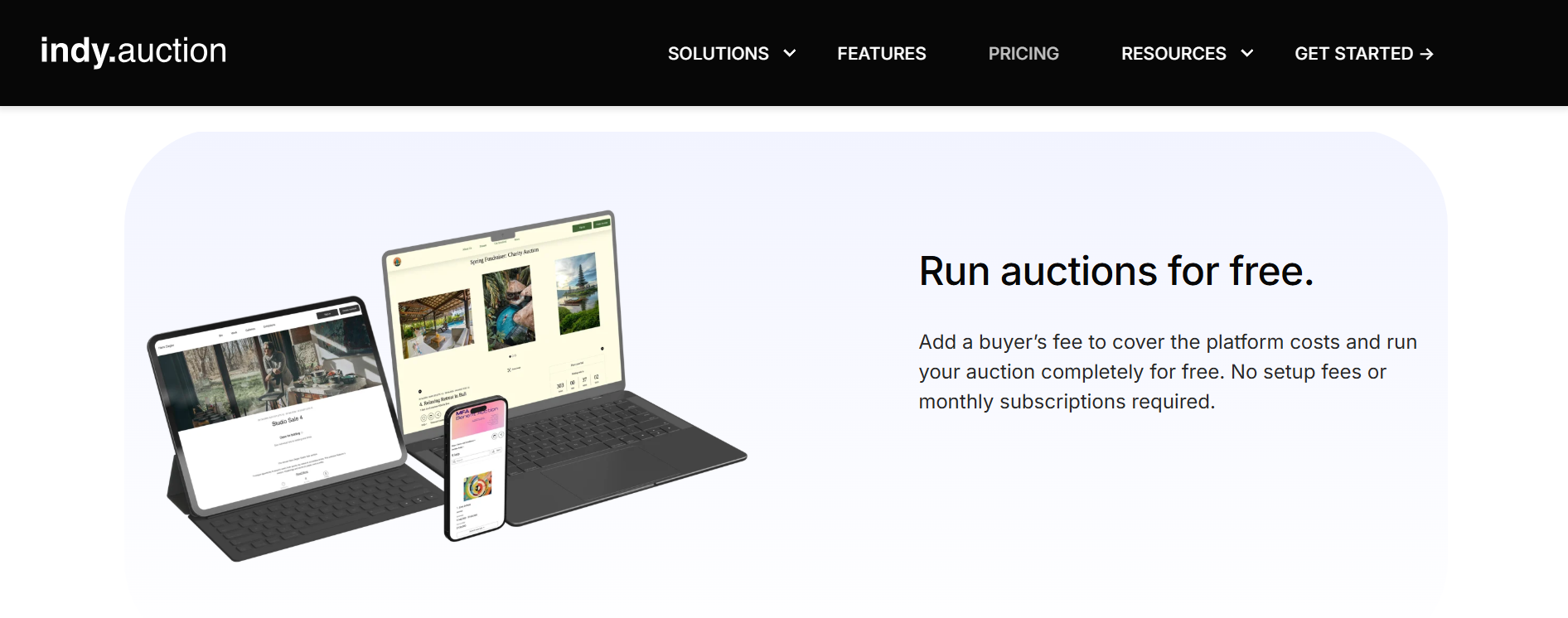
Indy.auction offers a clear, percentage-based model on sold lots, ranging between 6% and 9%. The platform charges no setup fees, no monthly subscriptions, and no hidden maintenance costs.
- Starter plan (6%): Designed for auctions with up to 100 lots, providing payment gateway integration, automated bidder emails, and registration management. Offers the option to pass the 6% fee onto buyers.
- Pro plan (9%): Unlocks complete design customisation, custom domain links, tailored email notifications, and advanced registration options. Also offers the option to pass the 9% fee onto buyers.
To make hosting completely cost-free, Indy.auction allows sellers to pass platform commission onto winning bidders through a buyer fee. Winning bidders pay this fee at checkout, allowing fundraising auctions, charity organisers, and individuals to retain 100% of their sale price.
Traditional auction houses
Traditional auction houses charge both the seller and the buyer, which creates dual fee layers on every lot sold.
- Seller's commission: Sellers pay between 10% and 15% of the hammer price to cover cataloguing, marketing, and appraisal services. For high value consignments at traditional auction houses, such as Christie’s or Sotheby’s, the seller’s commission is typically arranged privately on a case-by-case basis.
- Buyer's premium: Winning bidders pay a buyer premium that typically ranges from 15% to 25% on top of the hammer price.
When you combine both charges, traditional auction houses often collect between 25% and 40% of the total transaction value on a sold lot.
eBay

Online marketplaces like eBay charge a simplified final value fee on completed sales.
Seller fees:
- Final value fee: 12–15% of sale price (most categories ~13.6%)
- Below Standard penalty: +6% (or +7% after 4+ months)
- Top Rated Plus discount: −10% off final value fee. The ‘Top Rated Plus’ account status applies to eBay sellers who have been active for over 90 days, with 100+ transactions, and over $1,000 in sales across a 12 month period.
- Listing add-ons: Sellers can incur extra costs for setting reserve prices, promoting listings, or extending gallery features.
Buyer fees: None. eBay charges only the seller. The buyer pays the listed price.
LiveAuctioneers
LiveAuctioneers is not an auction house itself. It's a bidding platform that lets independent auction houses list their live sales for a global pool of online bidders.
Seller fees:
- Seller's commission: Set independently by each auction house, not by LiveAuctioneers.
- Varies widely by house and item value - often negotiable, especially for high-value consignments.
- LiveAuctioneers itself does not charge sellers directly; its cut comes from the buyer-side premium surcharge.
Buyer fees:
- Buyer's premium (paid by the buyer, on top of the hammer price): Set by the individual auction house's in-house rate, typically 20–26%+.
- LiveAuctioneers adds an extra 2–3% surcharge specifically for bidding through the platform (vs. bidding directly with the house or in person).
- Example: an auction house with a 26% in-house premium might charge ~28–31% for bids placed via LiveAuctioneers.
- Payment processing / convenience fees: Charged in addition to the buyer's premium and applied regardless of payment method (credit card, wire, etc.).
Whatnot

Seller fees:
- Commission: 8% standard (US/Canada/Australia); 6.67% + VAT (UK/EU); 5% electronics; 4% coins/money.
- Payment processing: 2.9% + flat fee, on total order value.
- 0% commission on the portion of a sale above ~$1,500 in select categories.
Buyer fees:
- A separate buyer protection fee exists, but it doesn't reduce the seller's payout. It's an added cost only for the buyer, layered on top of the item price.
Auction fees by platform at a glance:
|
Platform |
What it is |
Buyer pays |
Seller pays |
|
Indy.auction |
White-label auction software (self-run, own branding) |
Optional - seller can pass the platform fee to buyer |
Platform's % fee (seller's choice to absorb it or pass to buyers) + 1–3% payment processing |
|
eBay |
Direct marketplace |
Nothing extra |
12–15% final value fee |
|
LiveAuctioneers |
Bidding platform for independent auction houses |
House's premium + 2–3% platform surcharge + processing |
Auctioneer's commission (set by house) |
|
Whatnot |
Livestream auction marketplace |
Separate buyer protection fee |
~11% (8% commission + 2.9% processing) |
While many of these marketplaces provide access to existing buyer traffic, fees can accumulate quickly, and platforms offer limited control over custom branding or bidder data.
Start your auction with transparent pricing
Understanding fee structures ensures you choose the right platform for your fundraising goals, corporate event, or personal sale.
Indy.auction provides white-label auction software that gives you full control over your design, bidder experience, and fee options. You can create your auction with zero setup fees, zero monthly subscription charges, and total pricing clarity.
Sign up for free on Indy.auction and build your custom auction today.